
Ask the unit under test. Get a grounded answer.
In verification and validation, test data, BOMs, configurations and requirements live in separate systems. explore connects them into one Agentic Twin that answers in natural language, from verified relationships rather than guesswork.
The data exists. The answers do not.
Test results, BOMs, configurations and process documents live in systems that do not talk to each other. A single question, such as whether a failure mode already appeared on the prior BOM revision, takes hours of manual stitching.
The result is slow root-cause analysis, repeated tests, delayed releases and warranty exposure. And putting AI on a data lake just gives you fluent but untraceable answers.
Manual stitching
Every question means stitching across test management, PLM, ALM and sensor data, every time from scratch.
Plausible, not correct
RAG on the data lake retrieves similar-looking text, not the right relationship. It cannot reliably say which BOM revision a test run belonged to.
Not auditable
In V&V, a plausible-but-wrong answer is worse than none: a claim you cannot defend in an audit or a recall.
Repeated tests
Without a reliable history, tests get re-run instead of reused. That delays releases and ties up test capacity.
An Agentic Twin for verification and validation
explore unifies test data, the unit under test, its BOM, configuration and requirements in one semantic, type-safe layer, across every source system. Engineers ask in natural language, and the agent answers from verified relationships.
"Why did it fail, on which build, and where else is that part used?" is resolved in seconds, not hours. Every answer is traceable as a path back to the exact source record.
The twin does not only answer, it watches the BOM, configuration and test setup and flags risks in context, as a hint in the test-setup screen or the BOM editor, without being asked.
The value is in the relationships, not the data. Each source is useful alone. Connected by typed relationships, they answer questions none of them can answer by itself. Model the connections once, and every future question inherits them.
What the Agentic Twin delivers in V&V
Relationships as native traversal
Which run, which BOM, which config: a native graph traversal instead of fragile multi-table joins or lucky text matches.
Type safety through ontology
The schema enforces types. The agent can only connect what is allowed, so it cannot invent relationships that do not exist.
Multi-hop questions
From failure to part to supplier to other affected configurations: one query instead of a chain of manual steps.
Auditable answers
Every answer traces back to the exact source records, ready for audit, regulatory review and warranty defense.
Grounded by design
Question in, type-safe graph query out, grounded answer back. The agent only operates on verified structure, not on guesswork.
Two modes, one twin
Pull: you ask, the twin answers. Push: the twin checks the graph continuously and warns you in context before you ask.
The type-safe graph is the foundation that scales with you
A semantic, type-safe graph layer is the foundation everything builds on. Relationships are robust, type safety is guaranteed, and every answer is a provable path. Lay that foundation once and cost and risk stay flat as usage grows.
The data lake keeps its place: the test data itself can stay there; in the graph it is only referenced, not duplicated. The relationships and types live in the graph, the raw data where it already is.
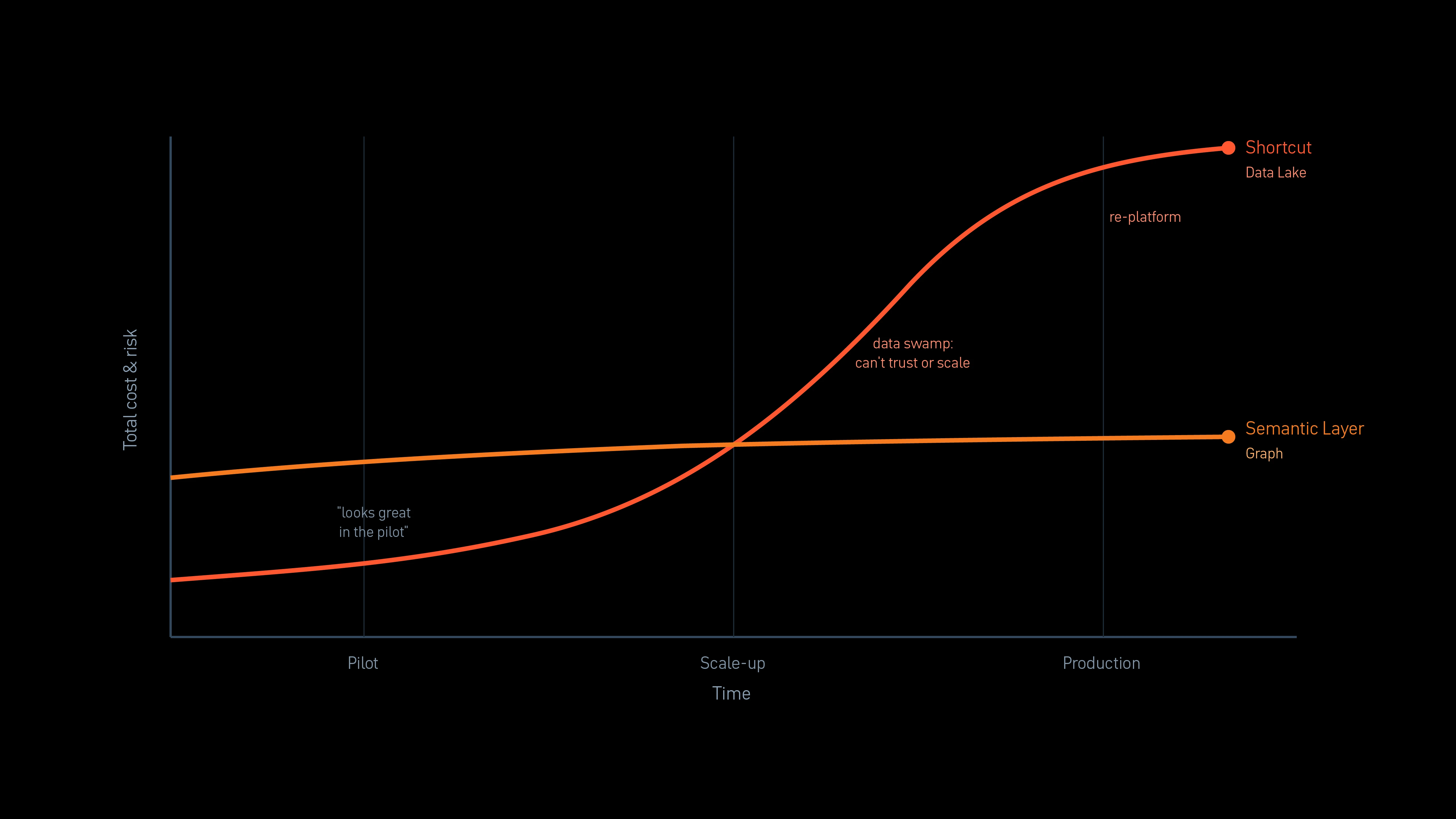
What the semantic layer pays back
Illustrative target values, to be validated per project.