
Product and factory as one shared Agentic Twin
In high-variant manufacturing, problems often surface only on the shop floor. explore validates every configuration up front on the digital twin, so you go into production faster, safer and without costly surprises.
Problems often surface on the shop floor, not in planning
In high-variant manufacturing, it only becomes clear late whether an ordered configuration can actually be built on the real line. Errors surface on the shop floor, not at the desk.
The result is rework, downtime, costly change loops and a delayed production start, while engineering, planning and manufacturing work from separate data states.
Late error detection
Clashes and non-buildable variants only surface on the shop floor.
Expensive rework
Errors in production mean scrap, rework and unplanned change loops.
Delayed production start
Every manual hand-off between engineering, planning and the line costs days.
Separate data states
Product, process and shop-floor data live in silos; nobody has the full picture.
One shared Agentic Twin of product and factory
explore connects the product and the factory into one shared Agentic Twin. Engineering, configuration, manufacturing planning and the shop floor converge on a single, consistent data foundation, across all systems and across time.
Every variant is represented as it was ordered, or, if not yet ordered, fully simulated as it could be ordered. The result is an end-to-end Digital Thread from the configured product to the real line, on which Lora AI analyzes, evaluates and acts in coordination.
All of this information is available to AI through Lora AI, either directly in the system or via MCP, so agents and tools can access the Agentic Twin seamlessly.
Unlike classic, static digital twins, the Agentic Twin is built for agentic AI: it does not just represent, it evaluates, decides and acts, continuously updated from real shop-floor data.
What the Agentic Twin delivers in manufacturing
Buildability check
For every ordered or simulated variant, explore validates automatically whether it can be built on the existing line, before it enters production.
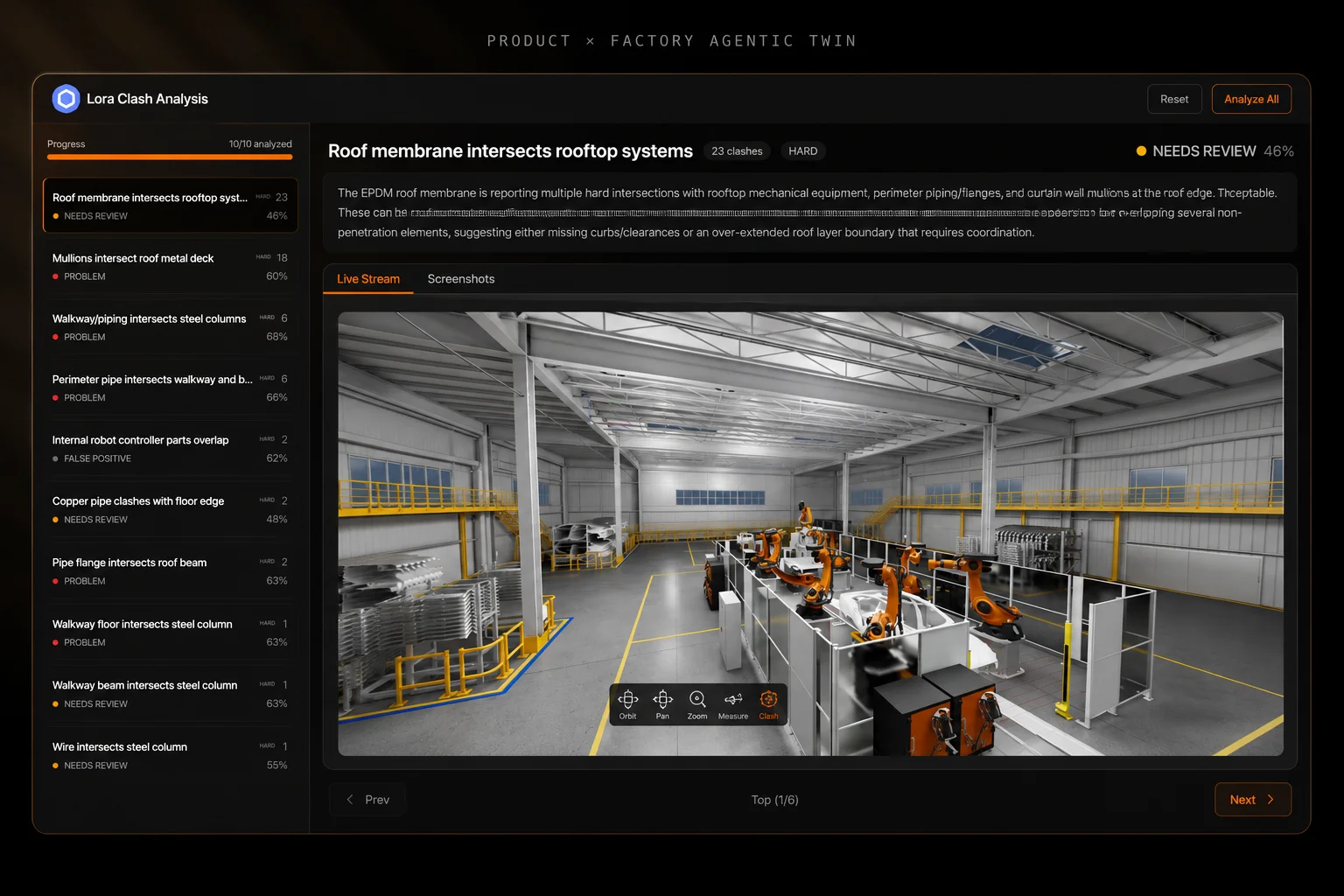
Lora Clash Analysis
Collisions between parts, fixtures and equipment are detected in the twin and evaluated in context, geometrically and along the entire process.
Assembly sequence
explore shows which parts are relevant at which station.
QM issues
Quality issues are pinned to the affected part and variant, with full traceability across product, process and time.
Decisions while the line runs
Fast, precise decisions while the line is running, based on the current state of product, line and order.
Catch problems early
The digital twin is validated before the BOM (bill of materials) goes into production. So problems are caught before they ever materialize on the shop floor.
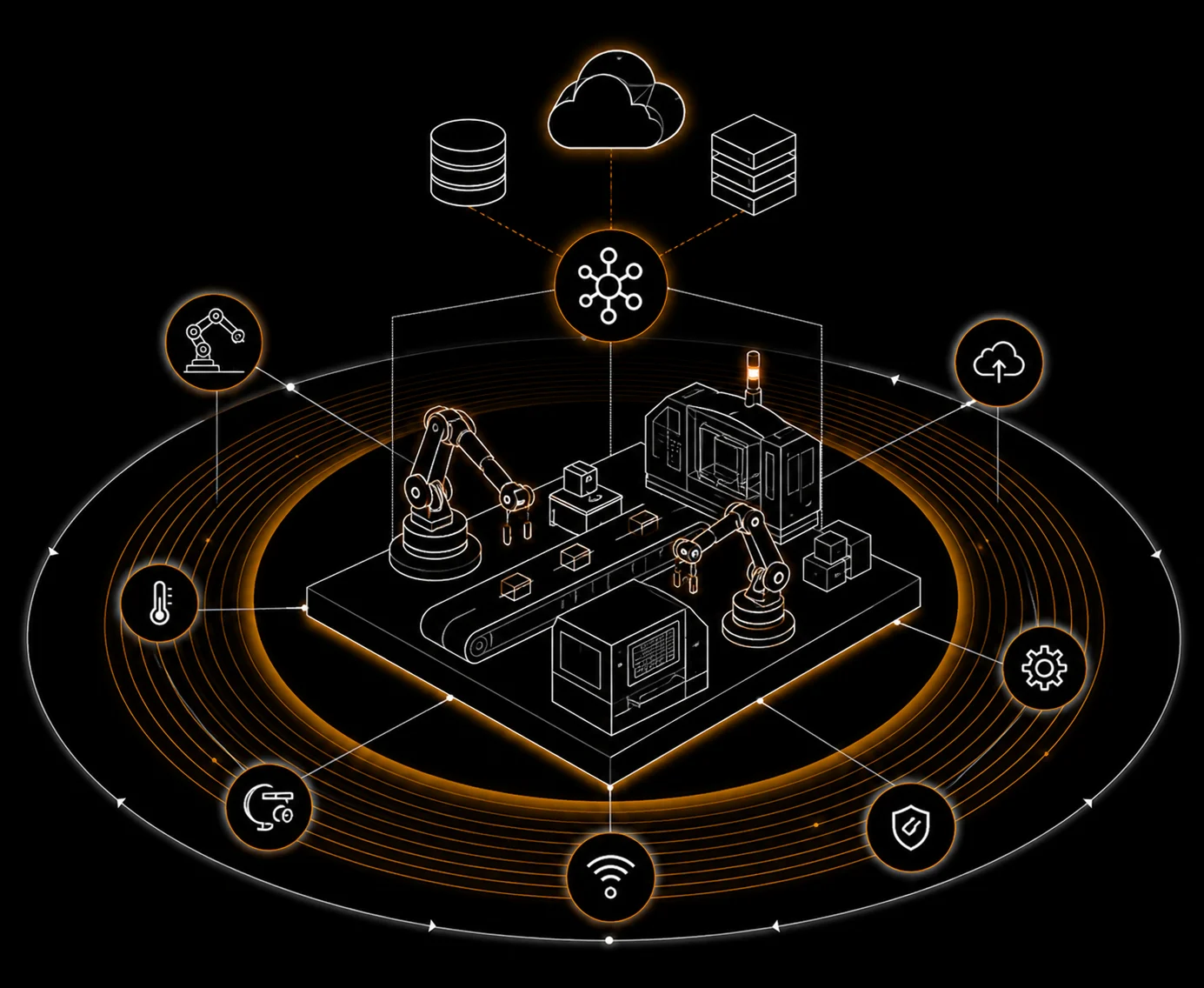
Shop-floor IoT events, processed in real time
The twin does not stay static: IoT events from the shop floor are processed continuously and mirrored back onto product and factory. So the Agentic Twin reflects the real state of production.
explore speaks OPC-UA as well as other modern IoT standards. Depending on topology, data is streamed via fog services close to the equipment or via cloud services through Kafka, scaling from a single cell to a plant network.
Measurable impact in manufacturing
Illustrative target values, to be validated per project.