
Why agents need a shared language, and why natural language alone is not enough
When agents coordinate in natural language, there has to be a shared, verifiable knowledge layer underneath. A recent study by the FAPS institute backs this up
 by Markus Herhoffer
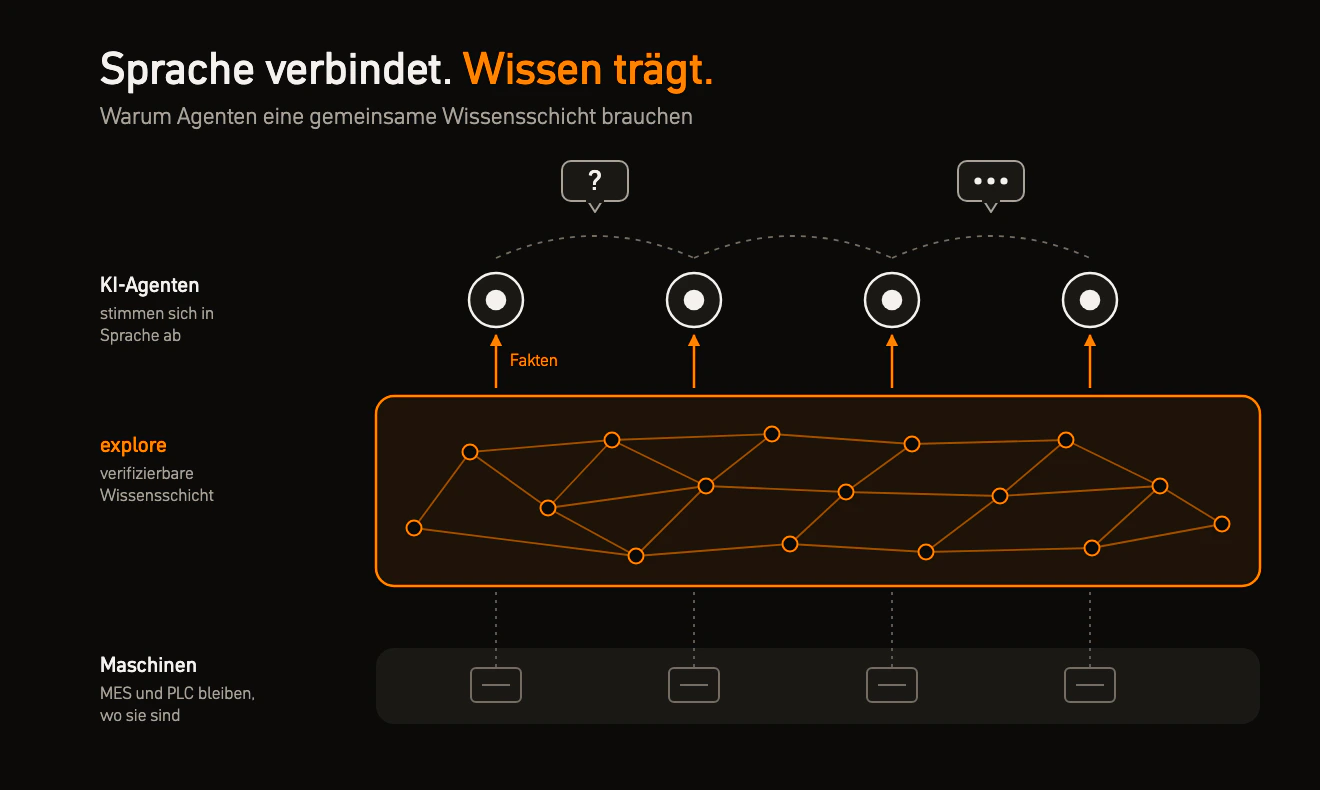
Language is the interface, not the knowledge
LLM agents are bringing new movement to an old idea: self-organizing manufacturing. Instead of following hard-coded sequences, agents coordinate in natural language and distribute tasks among themselves. That is real progress. But language is an interface, not a knowledge base.
As long as an agent's knowledge sits in its prompt, every agent has to ask the others what they know. Rules exist as prompt text, written out in several agents in parallel, and are hard to review, version or change centrally. With two agents that works. In a real factory with many resources, orders and dependencies, the coordination effort grows with every relationship.
Our thesis: a semantic layer beneath the language
If natural language is the interface between agents, there has to be something underneath it that all of them can refer to. We see that as an architectural layer of its own: states, rules and relationships are typed once and are available for every agent to query.
That changes three things:
- Fewer follow-up questions: an agent does not have to ask what another one knows. It queries the shared state of knowledge.
- Rules as data instead of prompt text: a rule is a typed object with relationships, reviewable, versionable, centrally changeable.
- Traceability: typed trace links record which facts an agent decision rests on. That is the basis for monitoring and audit.
Many to many instead of point to point
Decentralized coordination often needs many-to-many communication. Modeling it as requests between pairs of agents multiplies the connections. An event-based knowledge layer instead distributes state changes to everyone they concern.
The boundary matters. Control at machine level, MQTT, PLC, MES, stays where it is. A semantic layer sits above it and complements it: it gives agents the reliable context that language alone does not provide.
The evidence from research
How wide the gap is today is shown by a recent study by Krüger et al. (FAPS, CIRP CMS 2026). It tested two LLM agents, one for a robot, one for a lifting tower, in simulation and on a real demonstrator. The collision avoidance rule was written into the prompts of both agents, and the lifting tower agent had to ask the robot agent for the robot's position. Of 60 requests (Gemini 2.5 Flash), 61.7% were handled completely, 26.7% partially and 11.7% not at all or unusably, with response times of 1.0 to 11.8 seconds; there were no unintended actions. Common protocols such as A2A and ACP mainly model point to point relationships, according to the authors. Their recommendation points in the same direction as our thesis: hybrid architectures that combine LLM-based communication with verifiable, grounded decision making, plus mechanisms that monitor autonomous agent actions. The semantic layer itself is our conclusion, not part of the study.
Source
Krüger, J. H. et al.: Agentic AI for decentralized, natural-language communication and interaction between agents in self-organizing manufacturing systems. CIRP Conference on Manufacturing Systems (CIRP CMS) 2026, Procedia CIRP 146 (2026), pp. 90 to 95. doi.org/10.1016/j.procir.2026.03.192